Was there a true blue pike, or,
as the scientific community
claims, a colored variation of the walleye?
|
BLUE
PIKE OR IS IT JUST A DIFFERENT COLOR WALLEYE? Joe Ognibene
|
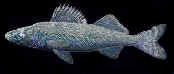 Was
there a true blue pike, or, as the scientific community
claims, a colored variation of the walleye?
Was
there a true blue pike, or, as the scientific community
claims, a colored variation of the walleye?|
“Today’s findings are in conflict with scientists, who in 1926 formally declaring the blue pike a different species. Back then, DNA was unheard of and blue pike commercial catches were tallied in the millions of pounds.” |
 It seems
strange that we can catch walleye, or yellow pike if you
prefer, in the lower Niagara that range in weight from a pound
or so to well over 10 pounds on the same fishing trip unlike
the consistent weights of blue pike catches. With less
pollutants entering the river, the walleye population is coming
back strong. Much of the credit goes to the Niagara River
Anglers Association as well as fish that have migrated across
Lake Ontario from Bay of Quinte, but there are not the schools
of same size walleye similar to what used to be with blue
pike. Stepien said in the late 1990s she found blue-colored
walleye caught in a Canadian lake had the same DNA as fish
caught in Lake Erie, proving the Canadian fish were walleye
and not blue pike. She said the color could come from the
particular area in the lake or river where the fish lives. She
said color variation is similar to puppies from the same
litter. “Some can be brown or white, others yellow, but they
are all the same puppies except for the color.”
It seems
strange that we can catch walleye, or yellow pike if you
prefer, in the lower Niagara that range in weight from a pound
or so to well over 10 pounds on the same fishing trip unlike
the consistent weights of blue pike catches. With less
pollutants entering the river, the walleye population is coming
back strong. Much of the credit goes to the Niagara River
Anglers Association as well as fish that have migrated across
Lake Ontario from Bay of Quinte, but there are not the schools
of same size walleye similar to what used to be with blue
pike. Stepien said in the late 1990s she found blue-colored
walleye caught in a Canadian lake had the same DNA as fish
caught in Lake Erie, proving the Canadian fish were walleye
and not blue pike. She said the color could come from the
particular area in the lake or river where the fish lives. She
said color variation is similar to puppies from the same
litter. “Some can be brown or white, others yellow, but they
are all the same puppies except for the color.”
Today’s findings are in conflict with scientists, who in 1926 formally declaring the blue pike a different species. Back then, DNA was unheard of and blue pike commercial catches were tallied in the millions of pounds.
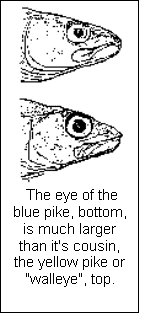
Records show that between 1950 and 1957 the annual take was 26 million pounds. In 1964, less than 200 pounds went to market. Shortly after, the United States and Canada declared the blue pike extinct. If today’s scientists are correct, why haven’t the huge schools of blue-colored walleye recovered similar to the “yellow pike?” An important point that cannot be overlooked is the appearance of the blue pike by comparison with the walleye. The blue had a more pointed nose and much larger eyes.
I’m sure this argument will go on for a long time and no firm answer will be found. Gary Isbell, head of the Ohio fisheries research program, pretty much summed it up when he said it’s time for anglers and scientists to give up the quest for a blue pike.
“We’ve
got serious issues on Lake Erie with other species,” he
said. “The blue pike are gone; it’s time to get over it.
IS THERE/WAS THERE A BLUE PIKE? YOU
DECIDE!
[OR JUST ASK SOME OF
THE OLD TIMERS
THAT MADE
A LIVING NETTING THEM!]
Mark Daul, Outdoors Niagara .com
The
picture shown below is from a USFWS field guide/brochure that
was being prepared at one time [about 1997] describing the
difference between a blue pike and a yellow pike.
Unfortunately, from my sources, the field guide/brochure never
materialized. The guide was intended for fishermen to take on
their fishing trips up into Canada where there had been
reports of “blue walleye”.
|
|
 Here
is an example of something you will find on our website and nowhere
else.
Here
is an example of something you will find on our website and nowhere
else.“Protective
measures already taken: In 1969, a pair of Lake Erie Stizostedion,
believed to be blue pike, were spawned at the Pennsylvania
Fish Commission's Linesville Fish Culture Station. About 9,000
of the fry were transferred to Gavins Point National Fish
Hatchery at Yankton, South Dakota. Some of the fingerlings
were stocked in an isolated lake in northern Minnesota.”
Remarks:
Data submitted by Dr. Stanford H. Smith, National Marine
Fisheries Service, Ann Arbor, Michigan and Region 3, U. S.
Fish and Wildlife Service, Twin Cities, Minnesota.
The
following is an example of an email received and as seen on
our website;
“Hello, I read your article and I loved it.
But I honestly think that the fish never went extinct and that
they have been alive all the time. I say that no matter what
anyone else says, a species is never totally extinct. There is
no way anyone can say that a fish is extinct because the
underwater environment is so secretive that you could be
staring at a so-called 'extinct' fish and not even know it.
Even the 'Experts' aren't always right. Take a look at the (Latimeria
chalumnae) or known as the Coelacanth, Scientists thought that
it had been extinct 50 million years ago and just at the
middle of the 20th century we discovered that they had been
hiding in the volcanic structures around the south African
shores. So never say a species is extinct.”
Thing that you won’t read anywhere else is on this website. Make sure you read the minutes of the “BLUE PIKE WORKSHOP” held July 17th 1997 by the USFS. It was held in Amherst NY. There is a list of attendees so you know who was present. Besides USFWS head, at the time, Dieter Busch, there was Carol Stepien, then of the Dept. of Biology, Case Western Res. University, who now heads the Great Lakes Environmental Genetics Laboratory at the Cleveland State University. Ms. Stepien is quoted in Joe Ognibene’s article above.
A NEW SCIENTIFIC NAME FOR WALLEYE
The world’s fish experts have suddenly agreed just recently to scrap the scientific name “Stizostedion vitreum” as the textbook definition for walleye. The new scientific name is now “Sander vitreus” for walleye. Sander is pronounced “Zander”.
For many, many years, “Sander” has been the scientific name on the other side of the Atlantic in Europe. [Since around1818].
The North American scientists agreed to the name change because Sander vitreum pre-dates Stizostedion vitreum. Now we are the same all around the world.
Gee, do you think they will taste the same?
Go Back To BLUE PIKE INDEX Page